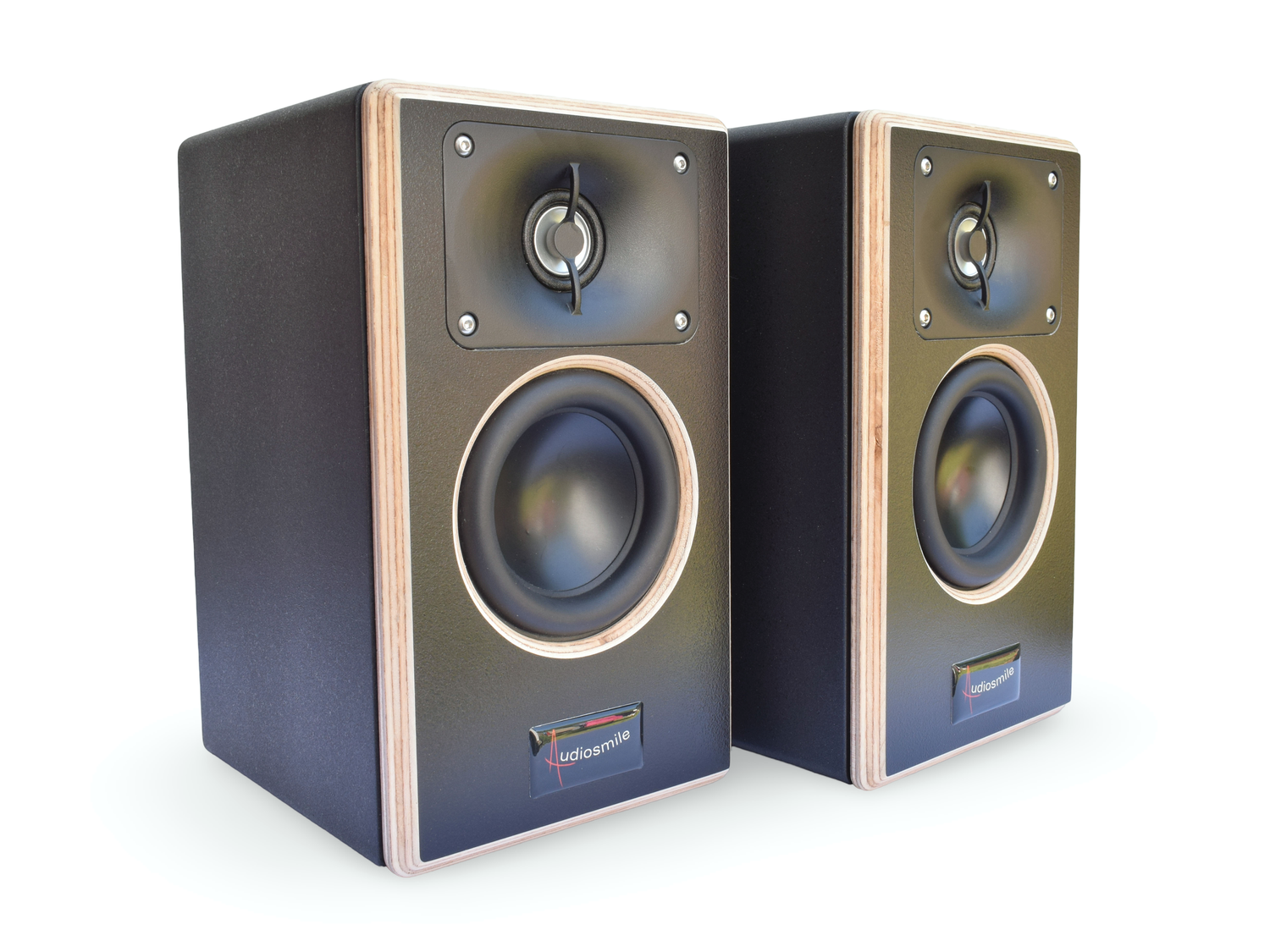
Foreword / YouTube Video Review
I was loaned these to review by the manufacturer. I was not paid nor did I receive any other form of compensation for this review. The speaker can be purchased as a kit or as a completed pair. I tested the completed pair.
All my reviews are done on my own time with great care to give you all the best set of data and information I can provide in order to help you make a well-informed purchase decision. I offer this for free to all who are interested. In return, if you want to support this site please see the bottom of this review for ways you can help. It is greatly appreciated.
- Size: 120 x 205 x 135 mm WHD
- Weight: Master 1.7 Kg, Slave 1.4 Kg
- Frequency Response: 58 Hz - 20 KHz -6dB
- Crossover: 1500Hz, 4th order acoustic, time-aligned, Analog Devices DSP
- Amplification: 50 watts Low Frequency, 50 watts High Frequency, Class A/B.
- Power Supply: Input 100 - 240 volts AC (universal). Output 15 volts DC, 6 amps
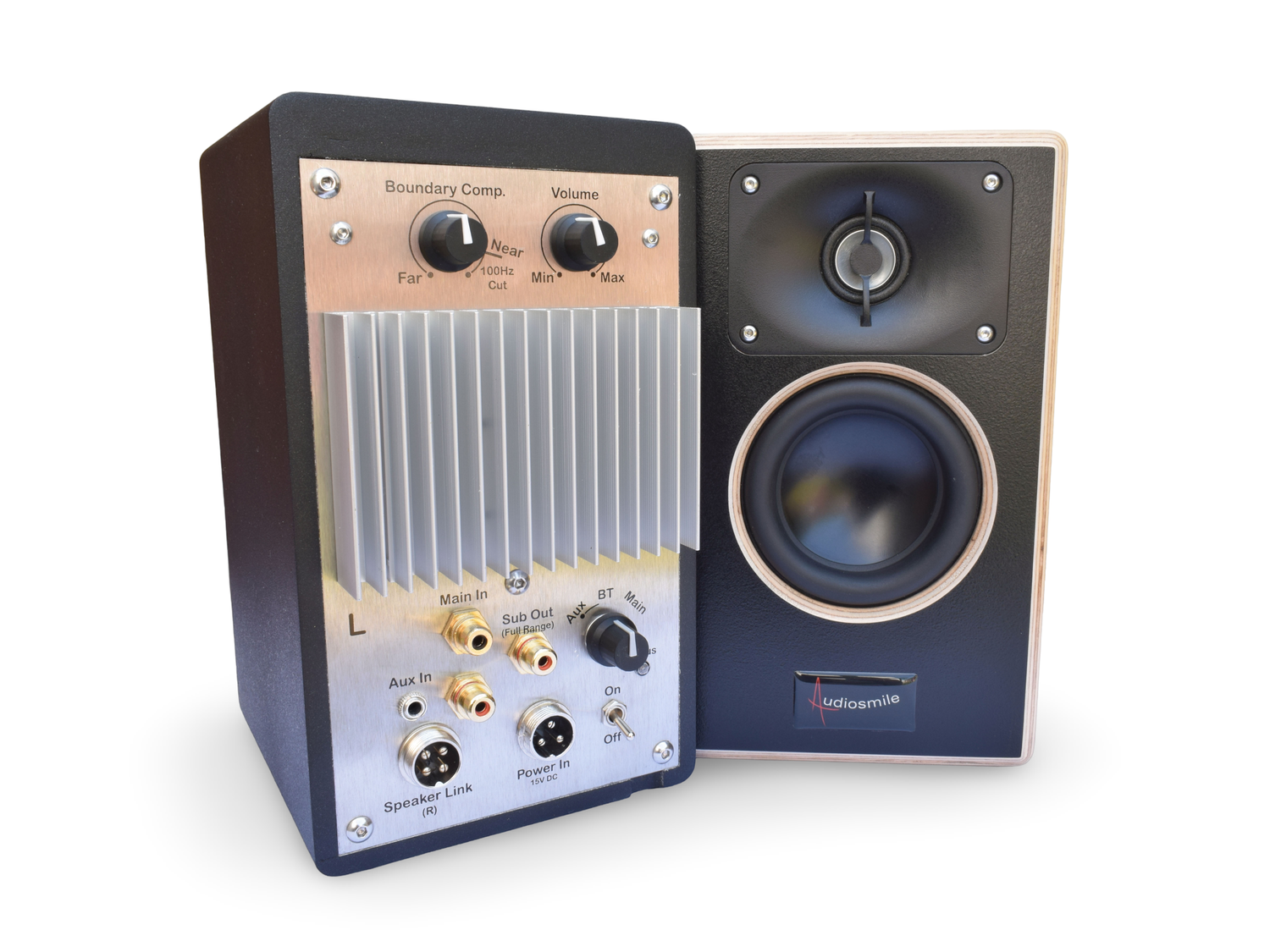
- Inputs: 3.5 mm Jack, RCA / Phono, Internal Bluetooth
- Bluetooth: CSR 8675 chipset with aptX HD Support
- Outputs: Subwoofer RCA. Full range, volume controlled
The Little British Monitor (LBM), is the distillation of high-end studio monitoring into a compact form. Designed from the ground up to excel in every metric, it’s perfect for those who demand purity of sound whether for mobile recording, desktop audio or simply to create an unobtrusive listening system with the added convenience of Bluetooth aptX HD connectivity.
- Linear Neutral Frequency Response: Experience flat and accurate frequency response with the LBM, ensuring your mixes translate perfectly and every detail of music is reproduced as intended.
- Optimized Port Design: AudioSmile identified port performance as the primary weakness of alternative products. The LBM’s port design is the result of extensive research to minimise unwanted noise and distortion of all types. The result is a sound purity typically found only in sealed box systems, combined with extended, dynamic bass reaching down to 58Hz.
- Constrained Visco-elastic Damping Layer Inside LBM 3 Port
- Wide-band Tweeter: The LBM’s unconventional tweeter takes over from the woofer at 1.5KHz, a full octave earlier than most small speakers. This design ensures superior driver integration and minimizes modulation by the woofer, delivering a more cohesive and open sound.
- Advanced Waveguide Technology: The wide-band tweeter features a meticulously designed waveguide that matches the woofer’s dispersion and minimizes diffraction effects. Additionally, an integrated phase lens broadens the sweet spot for the highest frequencies. This ensures a smooth, consistent off-axis response and a natural, expansive soundstage.
- State-of-the-Art DSP: In-house designed electronics drive the LBM. Integrated DSP active crossovers exact precise control over each driver ensuring time and phase alignment, driver excursion and amplifier clipping protection, and auto-standby functionality. Room boundary compensation allows the LBM to adapt seamlessly to any listening environment.
- Class A/B Amplification: Each driver in the LBM is powered by its own 50-watt Class A/B amplifier, providing clean low distortion power without the fatigue associated with many Class-D designs. The regulated supply delivers 100-watts of clean power and 4700uF of local capacitance provisions for effortless dynamic peaks.
- Superior Build Quality: Each LBM is hand built in England. The front baffle is crafted from 12mm birch plywood, chosen for its stylish appearance and excellent acoustic properties. The woofer is braced by steel bars, providing an inert foundation that minimizes coloration. The finish is a custom mixed fine textured black incorporating mica and metallic particles that subtly sparkle like star-light.
The LBM from AudioSmile is the result of meticulous research, advanced engineering, and a commitment to excellence. Whether you’re mixing, mastering, or simply enjoying your favorite tracks, the LBM provides the detail and accuracy you need to create and appreciate great music.
As of this writing MSRP is £529.00/pair for the completed set *or* you can buy the DIY kit for 349.00/pair. In US dollars this equates to approximately $715 USD/pair *or* $470 USD/pair.
Back:
CTA-2034 (SPINORAMA) and Accompanying Data
All data collected using Klippel’s Near-Field Scanner. The Near-Field-Scanner 3D (NFS) offers a fully automated acoustic measurement of direct sound radiated from the source under test. The radiated sound is determined in any desired distance and angle in the 3D space outside the scanning surface. Directivity, sound power, SPL response and many more key figures are obtained for any kind of loudspeaker and audio system in near field applications (e.g. studio monitors, mobile devices) as well as far field applications (e.g. professional audio systems). Utilizing a minimum of measurement points, a comprehensive data set is generated containing the loudspeaker’s high resolution, free field sound radiation in the near and far field. For a detailed explanation of how the NFS works and the science behind it, please watch the below discussion with designer Christian Bellmann:
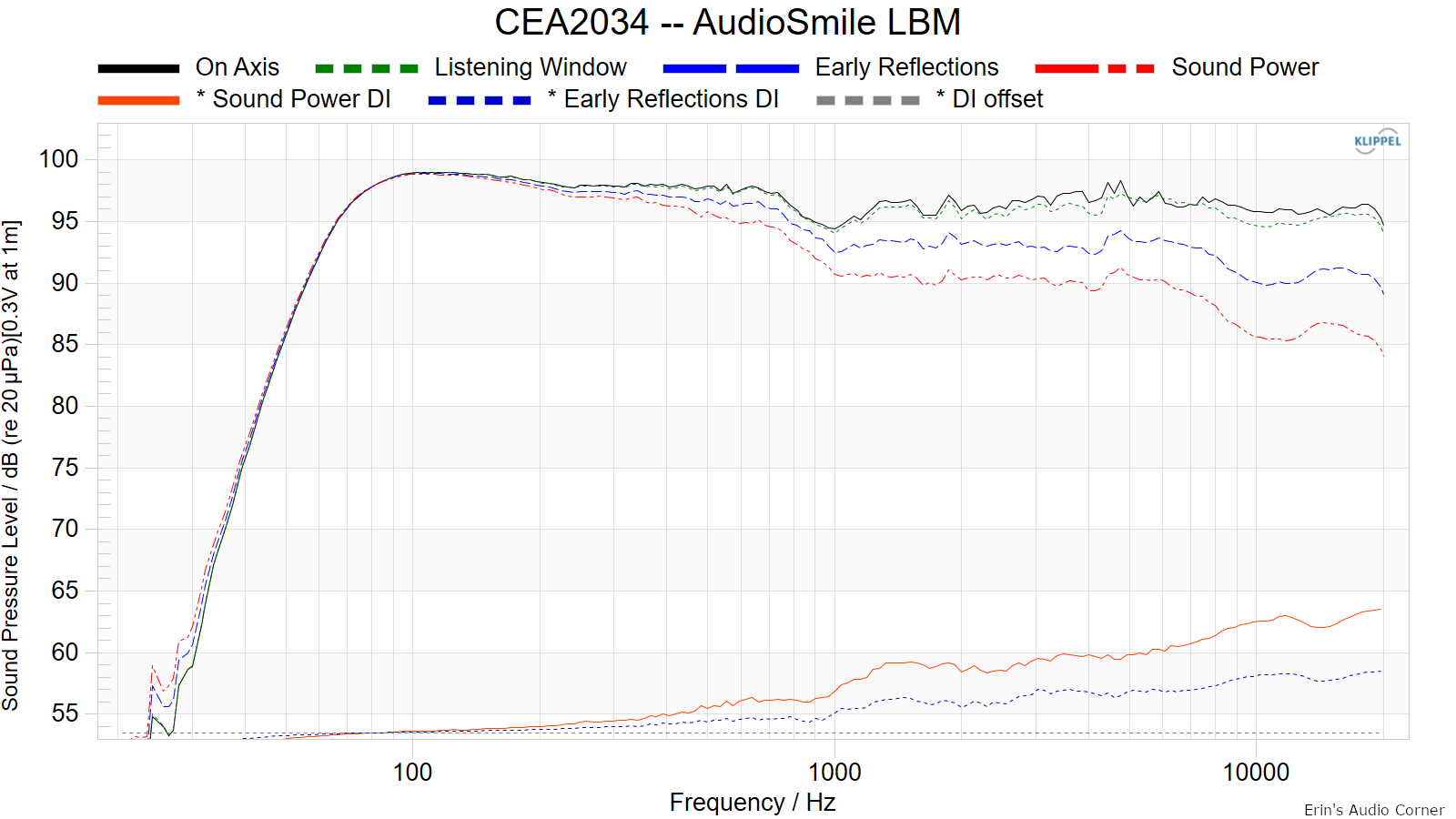
IMPORTANT SETUP INFO: This speaker was measured with the reference point at the tweeter. Speaker was broken in. This speaker has various DSP options for boundary compensation. My testing was conducted with the boundary setting to “far” which results in an elevated bass profile. For a more nominally flat response the boundary setting should be positioned at the 12 o’clock position. These results are shown on Audio Science Review’s review (whew, redundancy!). Here is a link.
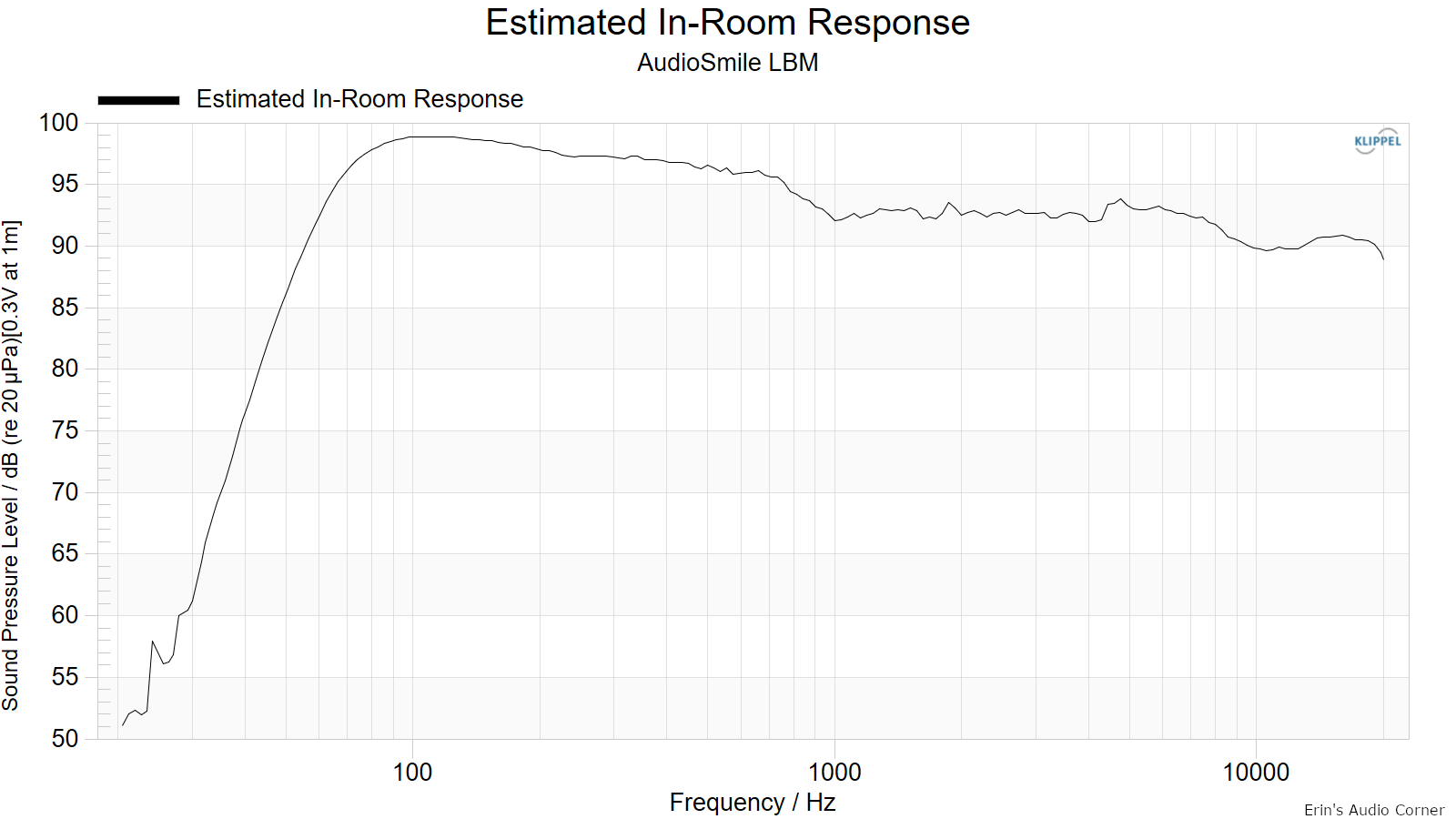
Note: This is absoltely a desktop speaker and not intended for any listening in a farfield environment. Therefore, be cautious to not evaluate this speaker’s performance based on farfield conditions. Evaluate the speaker on the on-axis or slightly off-axis anechoic response rather than the estimated in-room response.
Measurements are provided in a format in accordance with the Standard Method of Measurement for In-Home Loudspeakers (ANSI/CTA-2034-A R-2020). For more information, please see this link.
CTA-2034 / SPINORAMA:
The On-axis Frequency Response (0°) is the universal starting point and in many situations it is a fair representation of the first sound to arrive at a listener’s ears.
The Listening Window is a spatial average of the nine amplitude responses in the ±10º vertical and ±30º horizontal angular range. This encompasses those listeners who sit within a typical home theater audience, as well as those who disregard the normal rules when listening alone.
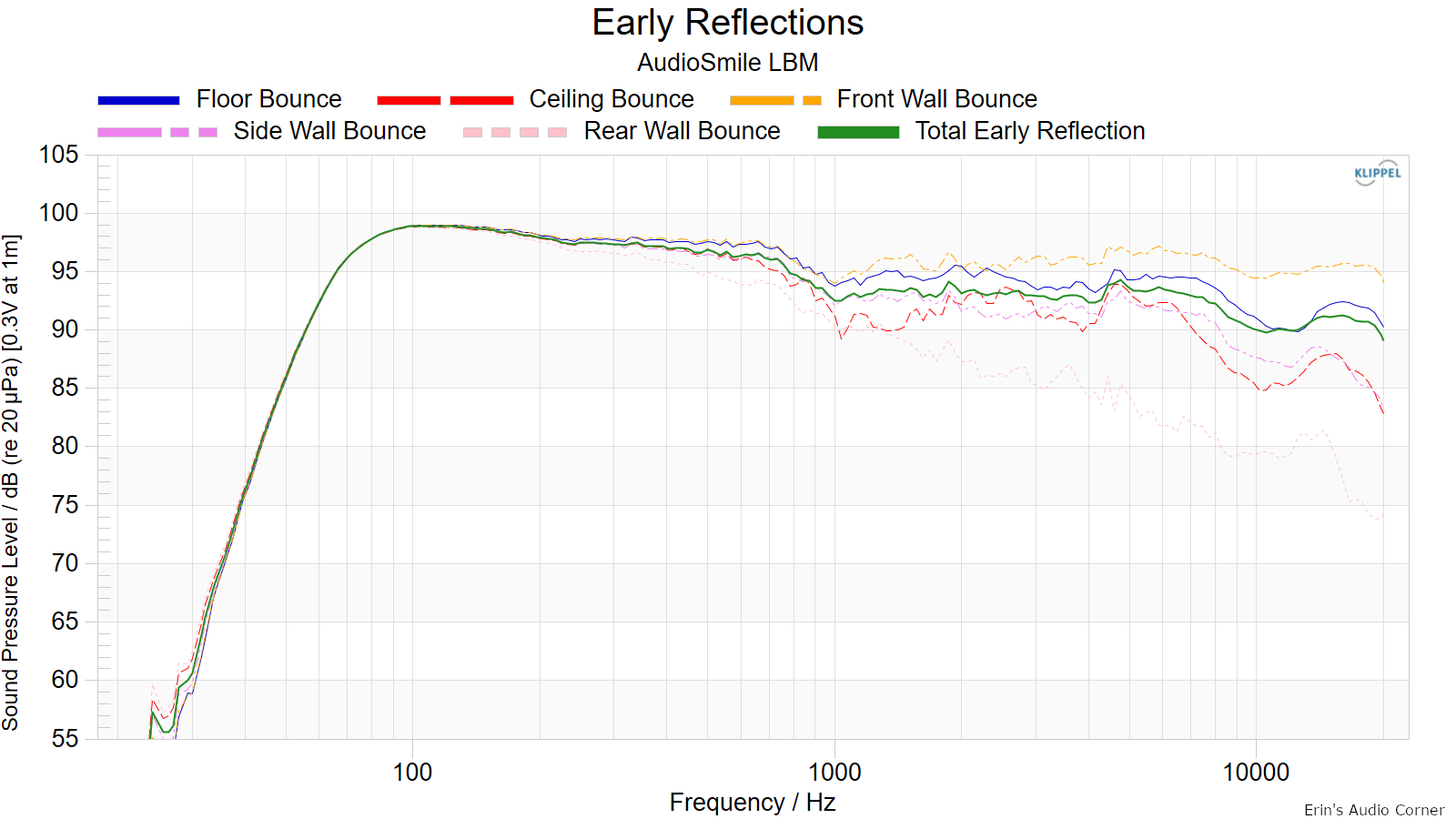
The Early Reflections curve is an estimate of all single-bounce, first-reflections, in a typical listening room.
Sound Power represents all of the sounds arriving at the listening position after any number of reflections from any direction. It is the weighted rms average of all 70 measurements, with individual measurements weighted according to the portion of the spherical surface that they represent.
Sound Power Directivity Index (SPDI): In this standard the SPDI is defined as the difference between the listening window curve and the sound power curve.
Early Reflections Directivity Index (EPDI): is defined as the difference between the listening window curve and the early reflections curve. In small rooms, early reflections figure prominently in what is measured and heard in the room so this curve may provide insights into potential sound quality.
Early Reflections Breakout:
Floor bounce: average of 20º, 30º, 40º down
Ceiling bounce: average of 40º, 50º, 60º up
Front wall bounce: average of 0º, ± 10º, ± 20º, ± 30º horizontal
Side wall bounces: average of ± 40º, ± 50º, ± 60º, ± 70º, ± 80º horizontal
Rear wall bounces: average of 180º, ± 90º horizontal
Estimated In-Room Response:
In theory, with complete 360-degree anechoic data on a loudspeaker and sufficient acoustical and geometrical data on the listening room and its layout it would be possible to estimate with good precision what would be measured by an omnidirectional microphone located in the listening area of that room. By making some simplifying assumptions about the listening space, the data set described above permits a usefully accurate preview of how a given loudspeaker might perform in a typical domestic listening room. Obviously, there are no guarantees, because individual rooms can be acoustically aberrant. Sometimes rooms are excessively reflective (“live”) as happens in certain hot, humid climates, with certain styles of interior décor and in under-furnished rooms. Sometimes rooms are excessively “dead” as in other styles of décor and in some custom home theaters where acoustical treatment has been used excessively. This form of post processing is offered only as an estimate of what might happen in a domestic living space with carpet on the floor and a “normal” amount of seating, drapes and cabinetry.
For these limited circumstances it has been found that a usefully accurate Predicted In-Room (PIR) amplitude response, also known as a “room curve” is obtained by a weighted average consisting of 12 % listening window, 44 % early reflections and 44 % sound power. At very high frequencies errors can creep in because of excessive absorption, microphone directivity, and room geometry. These discrepancies are not considered to be of great importance.
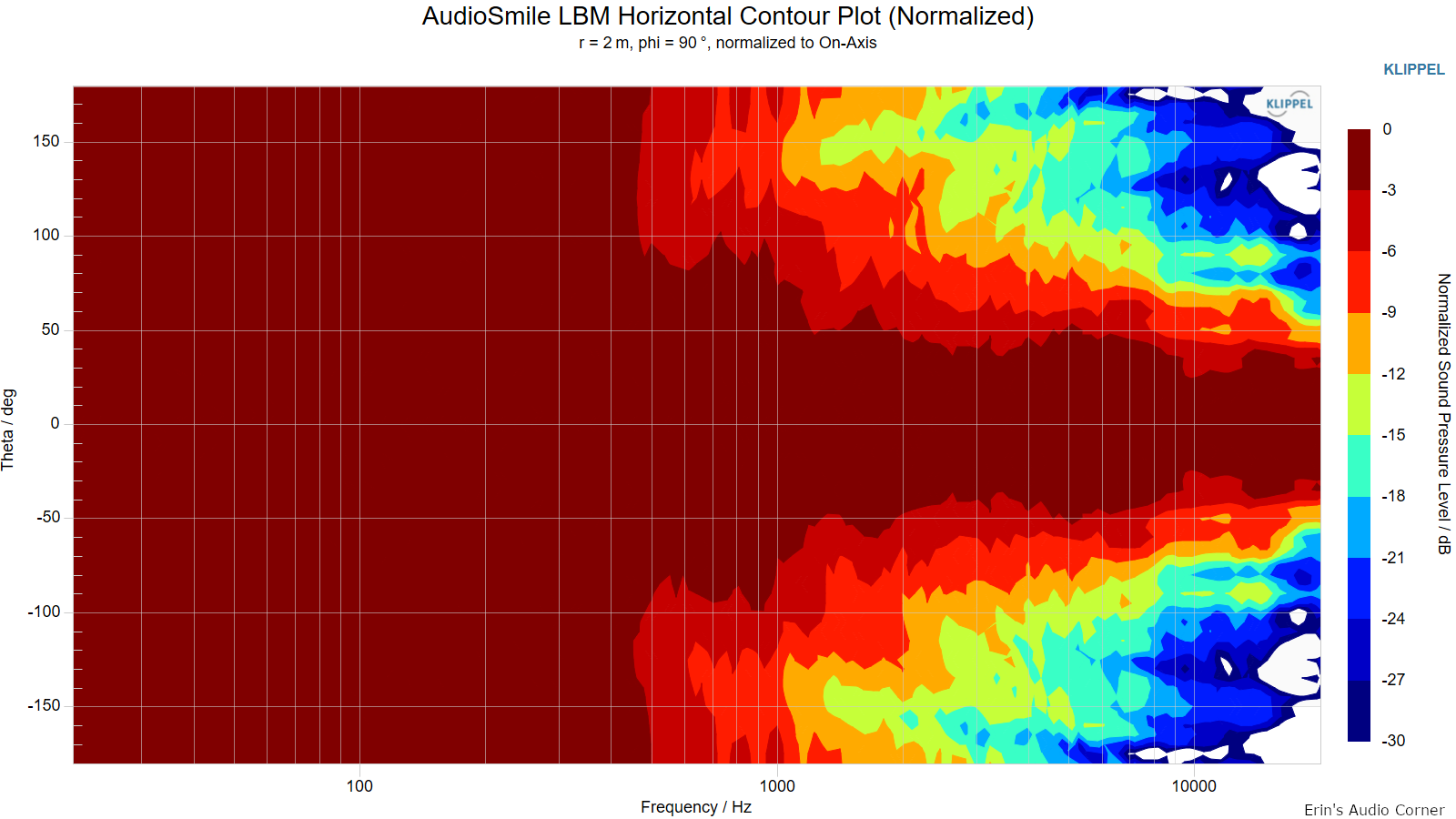
Horizontal Contour Plot (normalized):
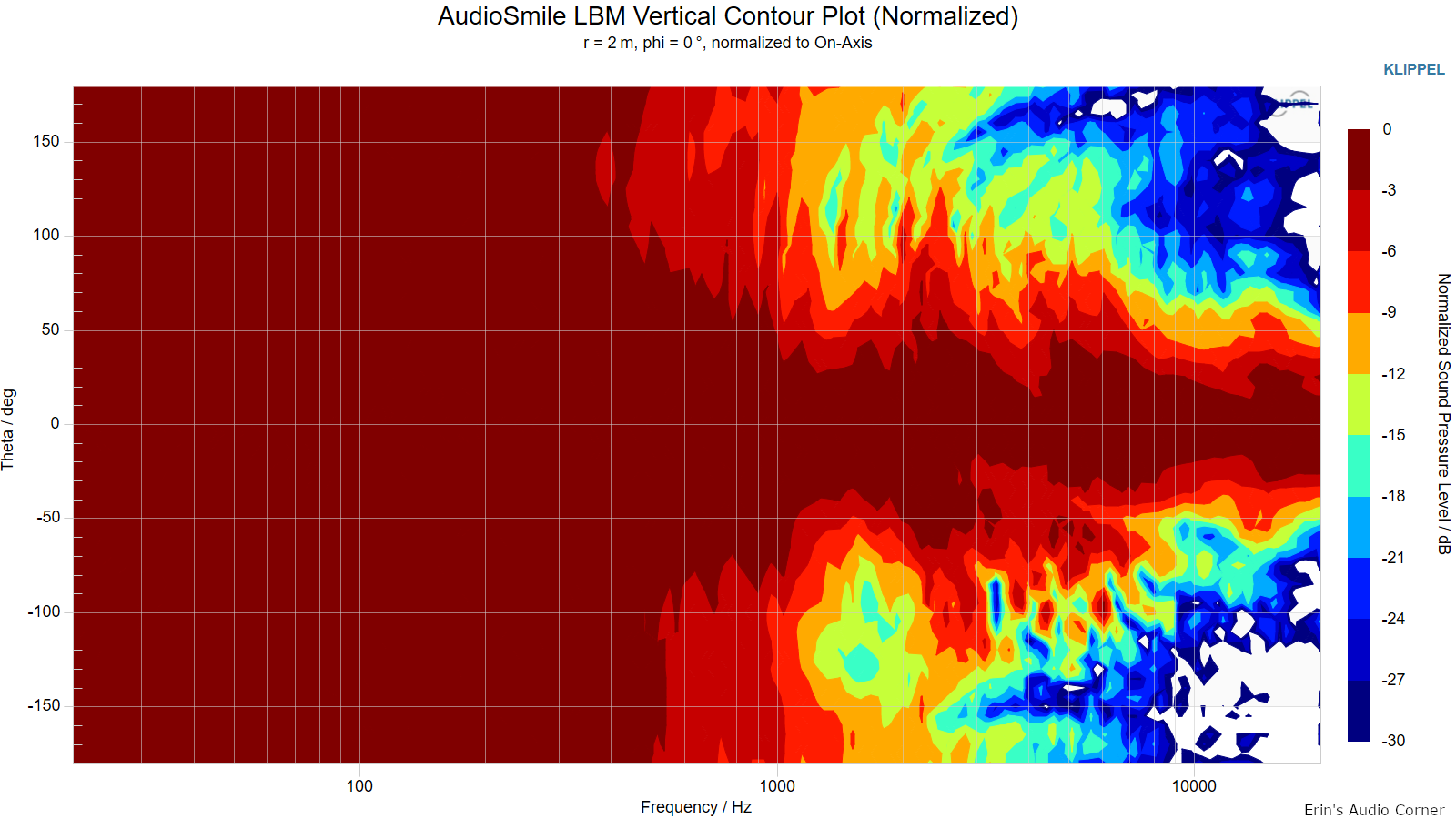
Vertical Contour Plot (normalized):
Additional Measurements
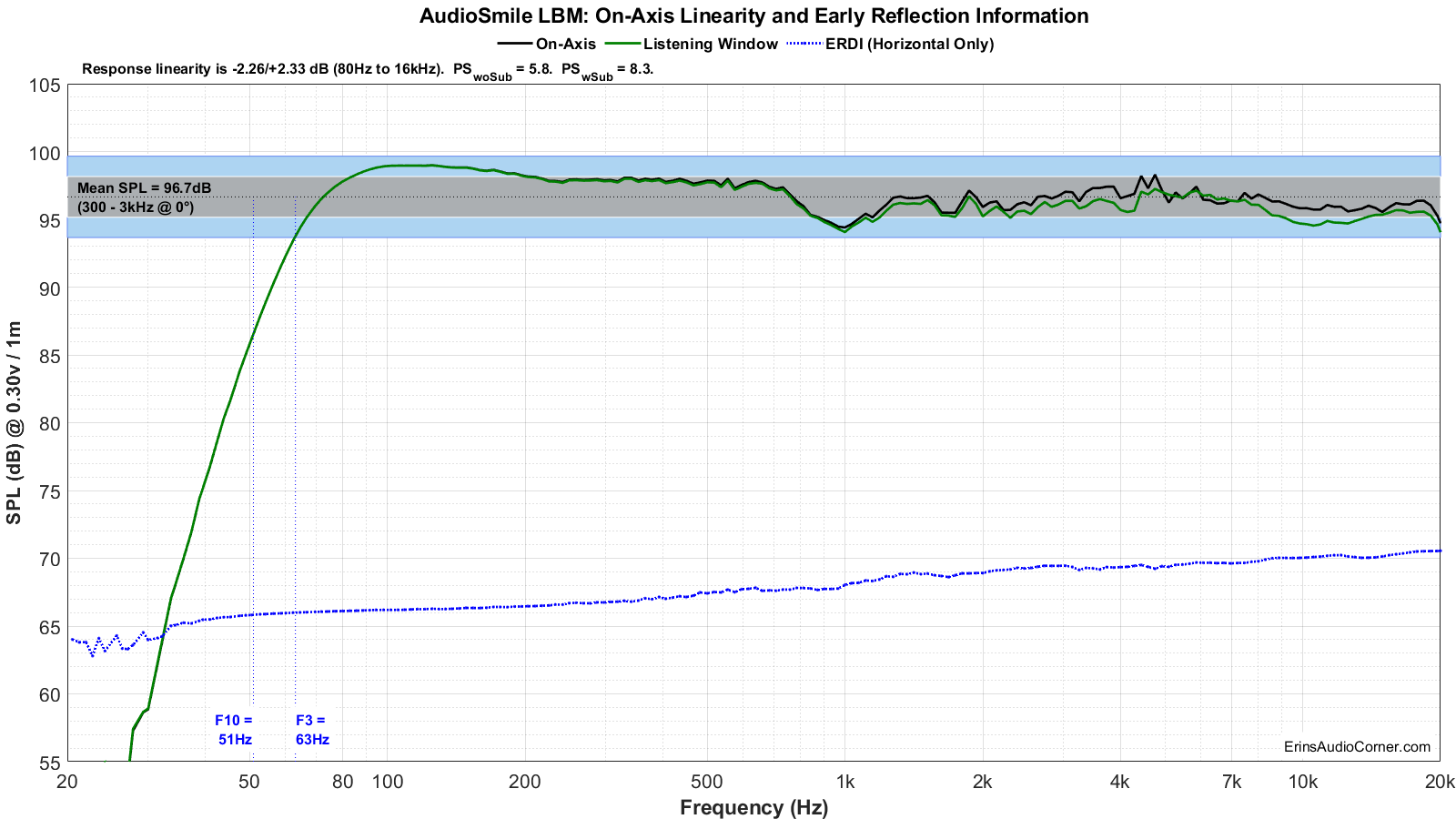
Response Linearity
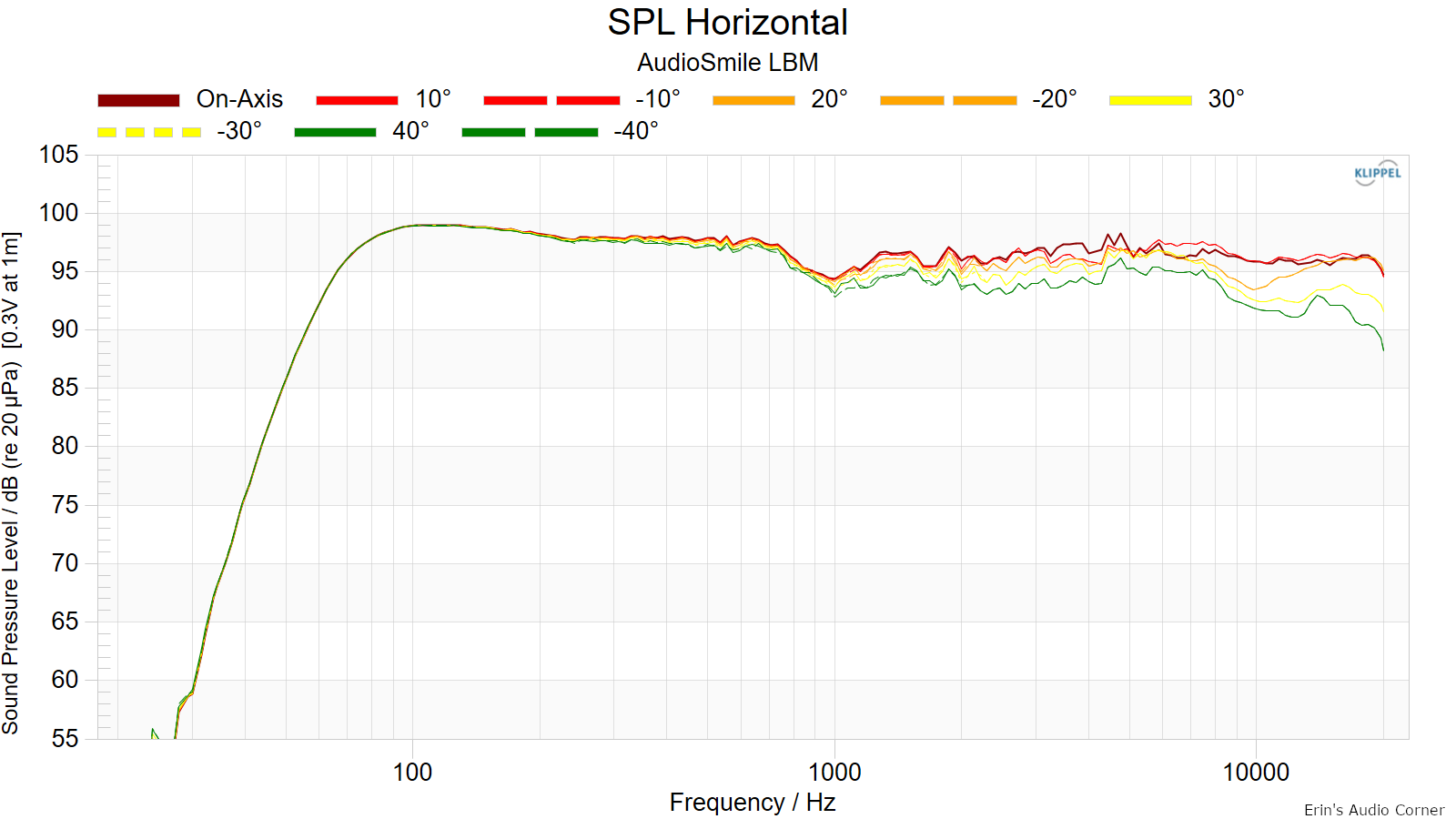
Horizontal Frequency Response:
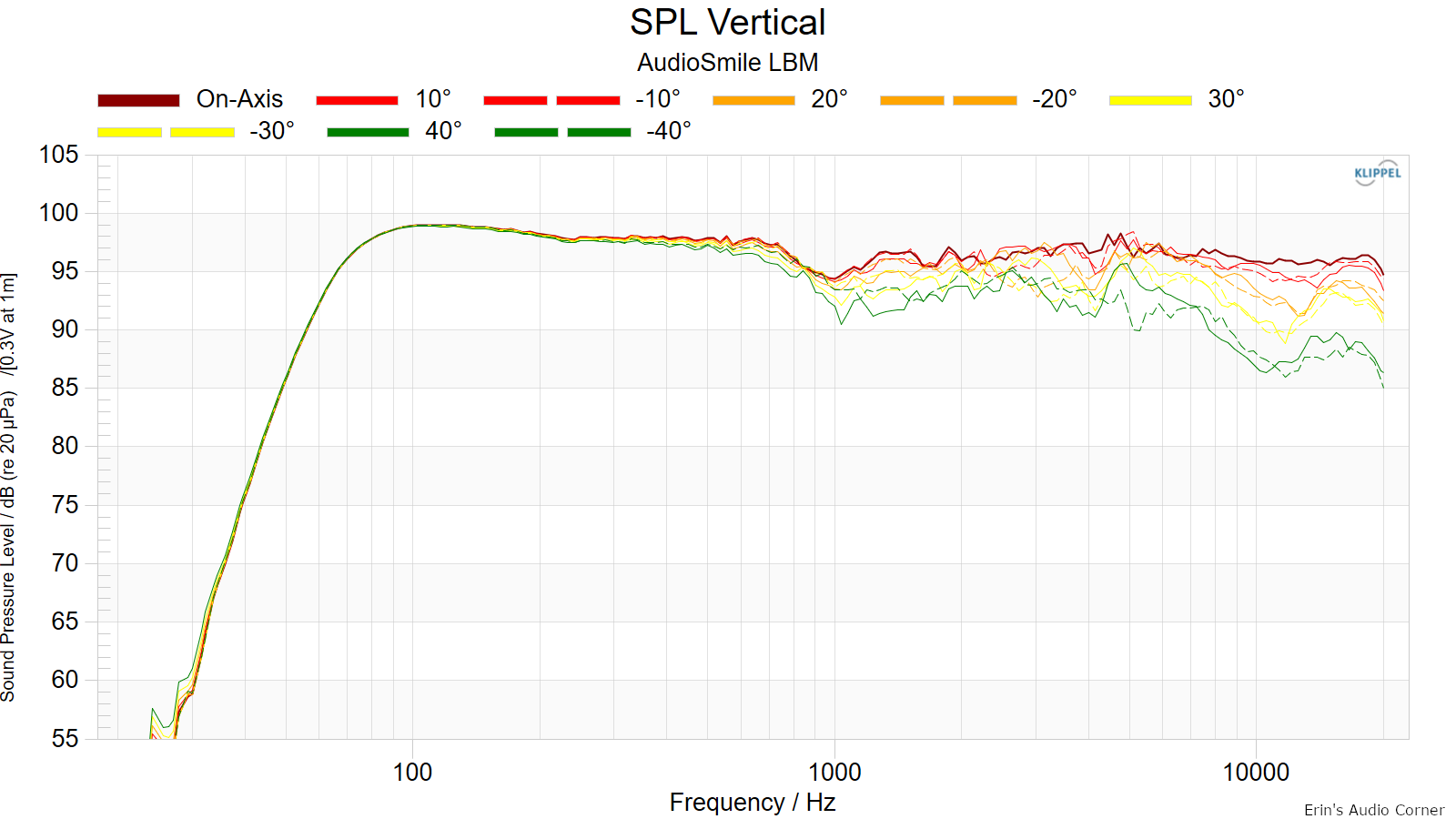
Vertical Frequency Response:
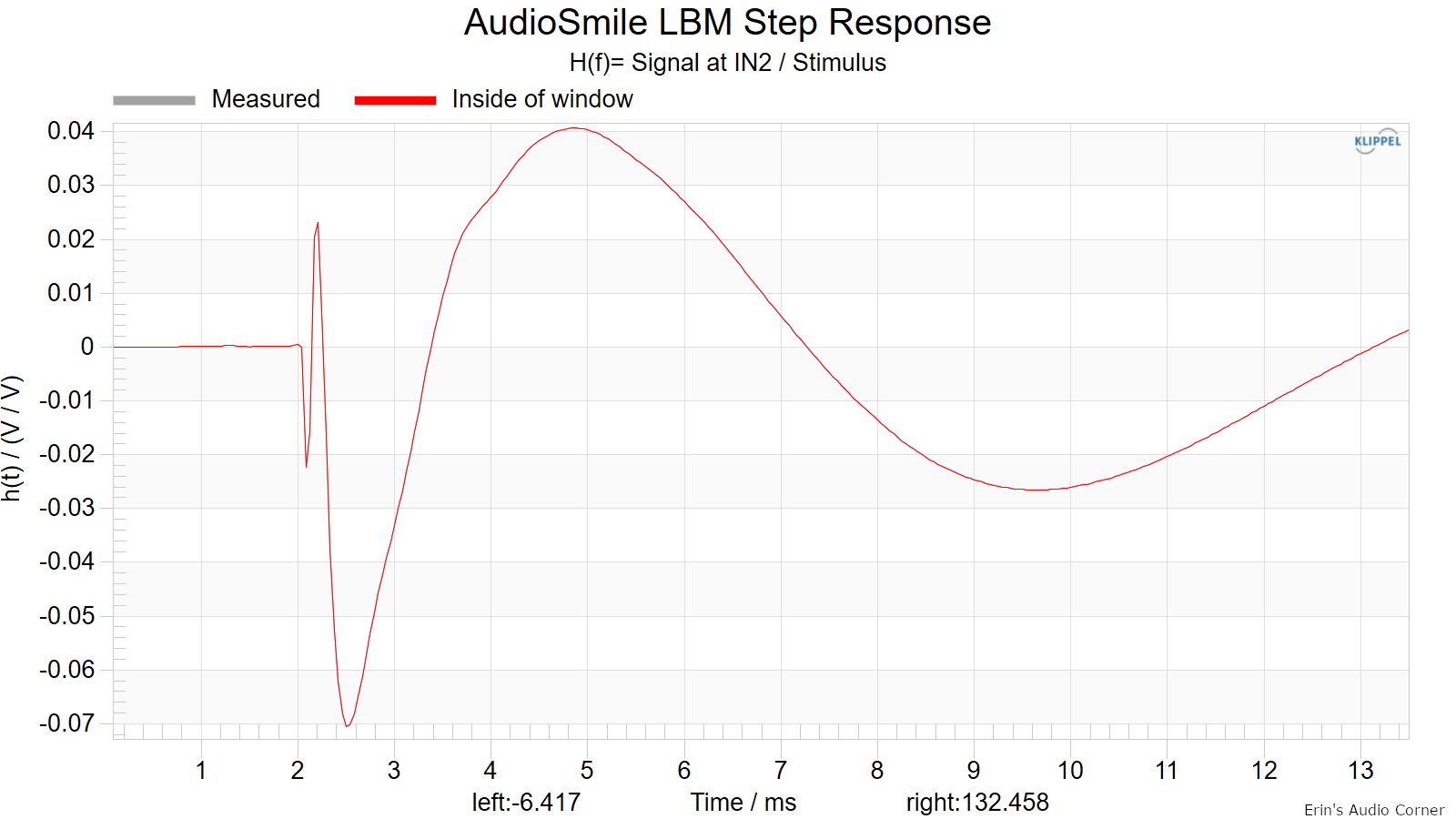
Step Response
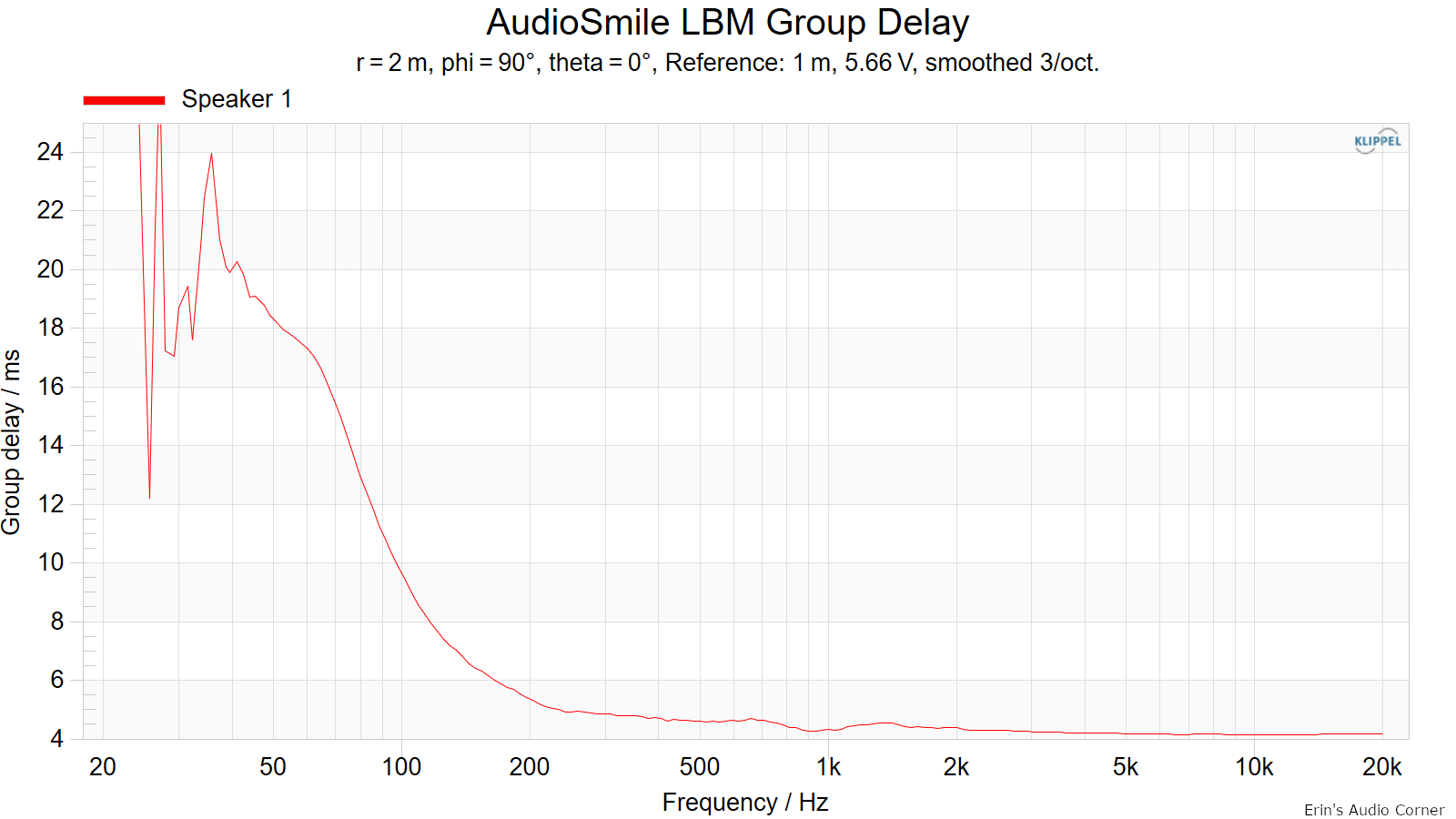
Group Delay
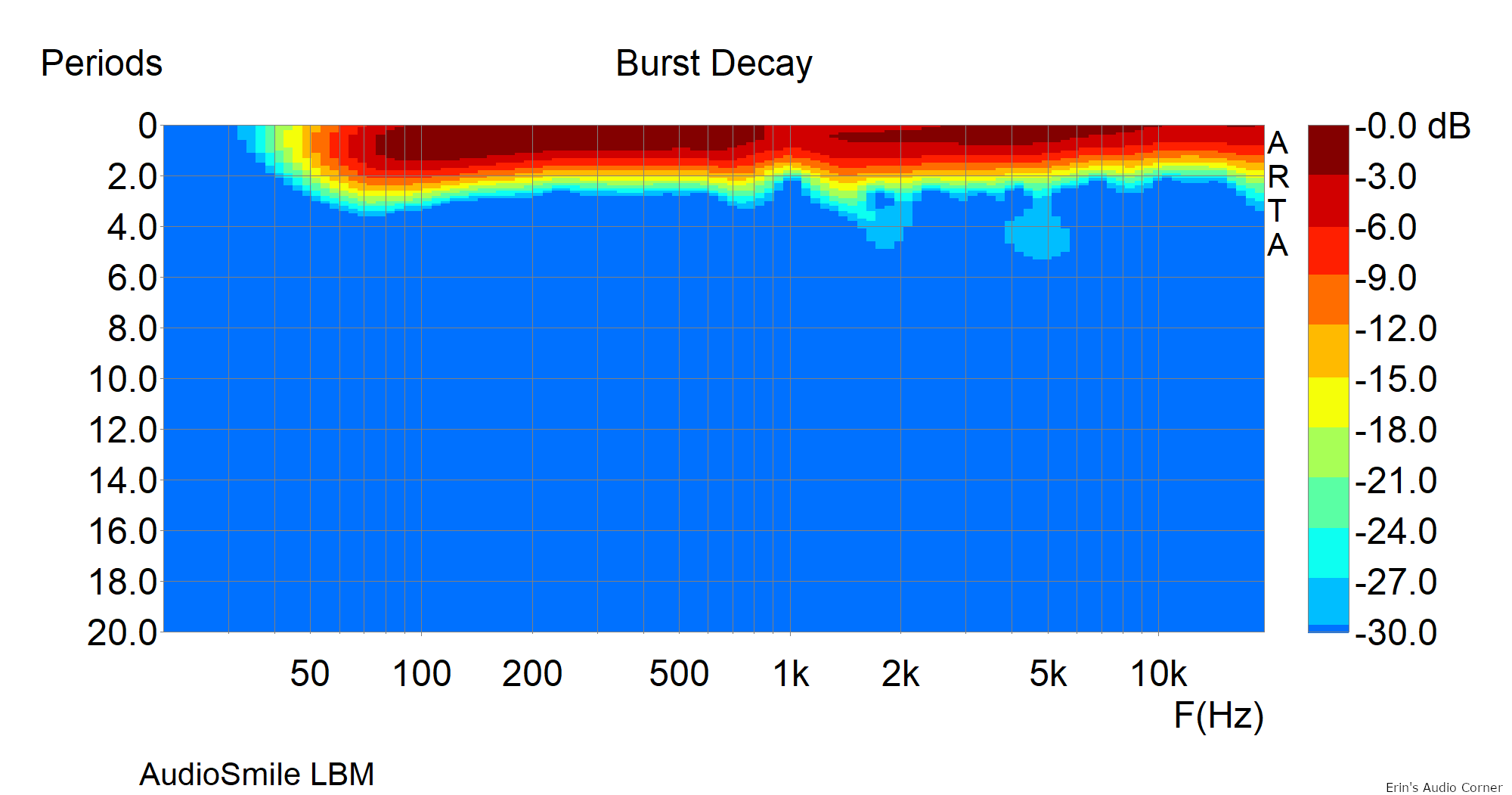
Burst Decay
This data is full anechoic where most spectral decay type graphics are created using quasi-anechoic data. For more information on the differences between Burst Decay and Cumulative Spectral Decay (CSD) graphics please see Section 6.5 of the ARTA User Manual linked below. I would like to extend a professional "thank you" to Ivo Mateljan for this software.
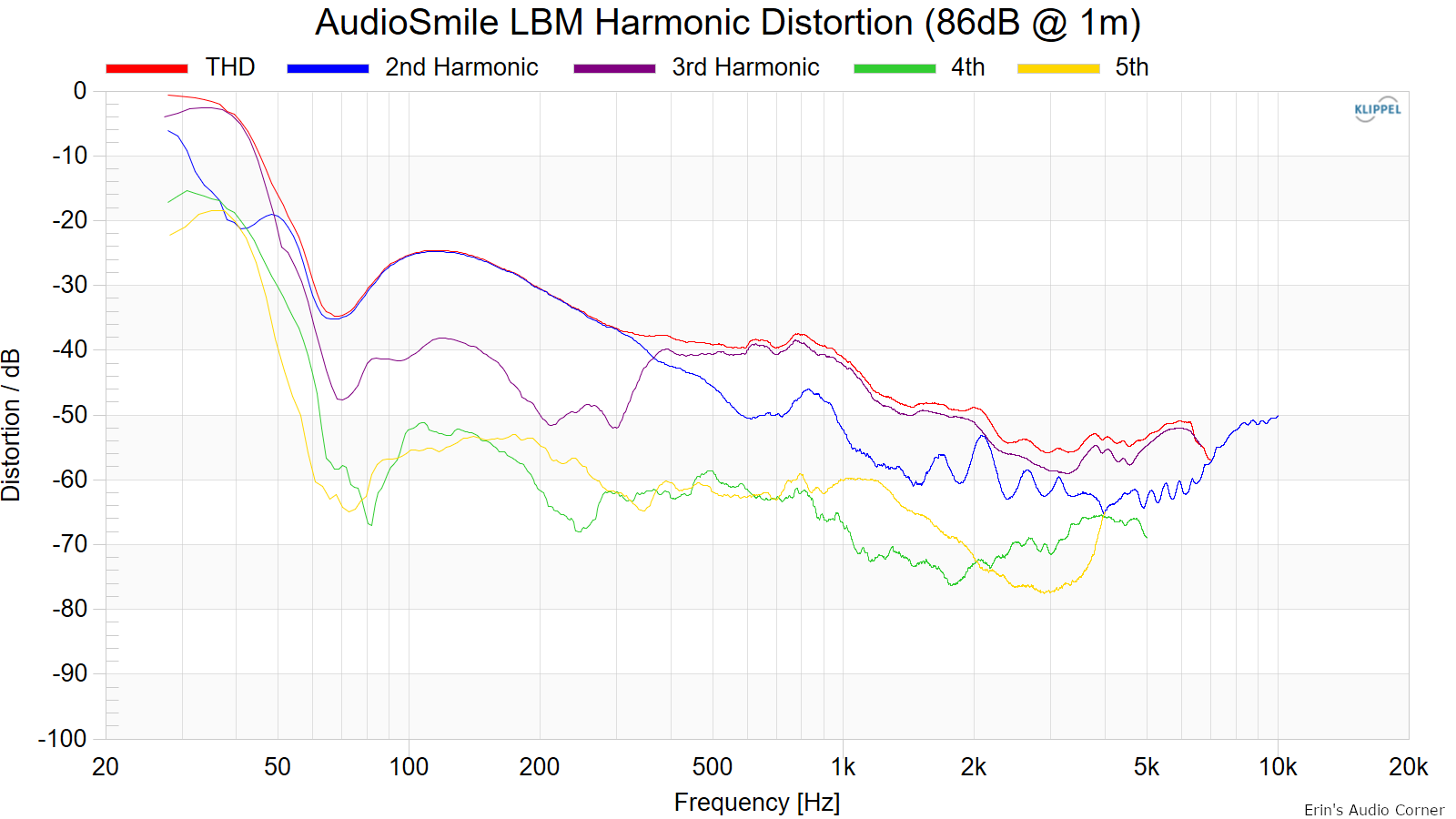
Harmonic Distortion
Harmonic Distortion at 86dB @ 1m:
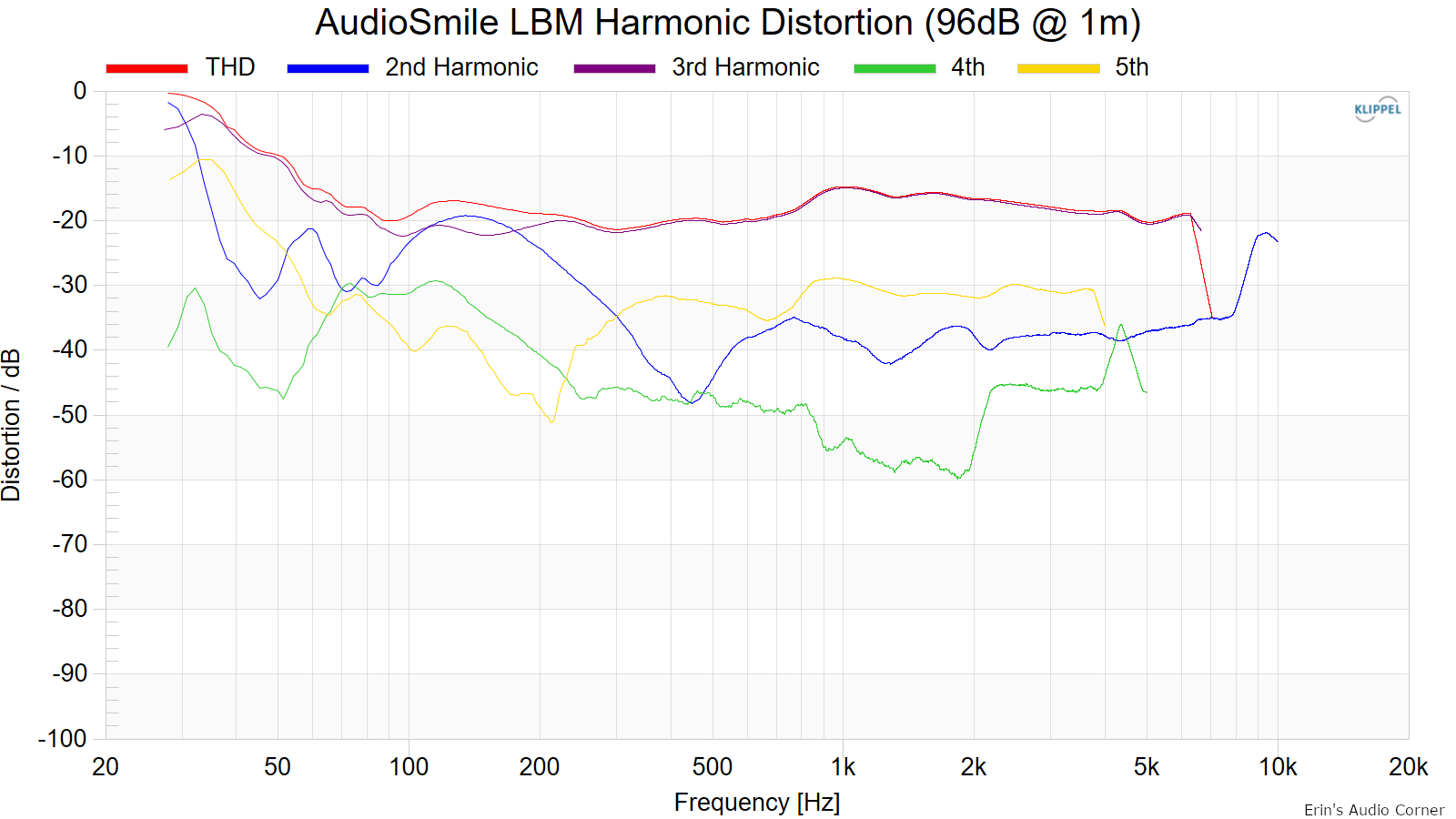
Harmonic Distortion at 96dB @ 1m:
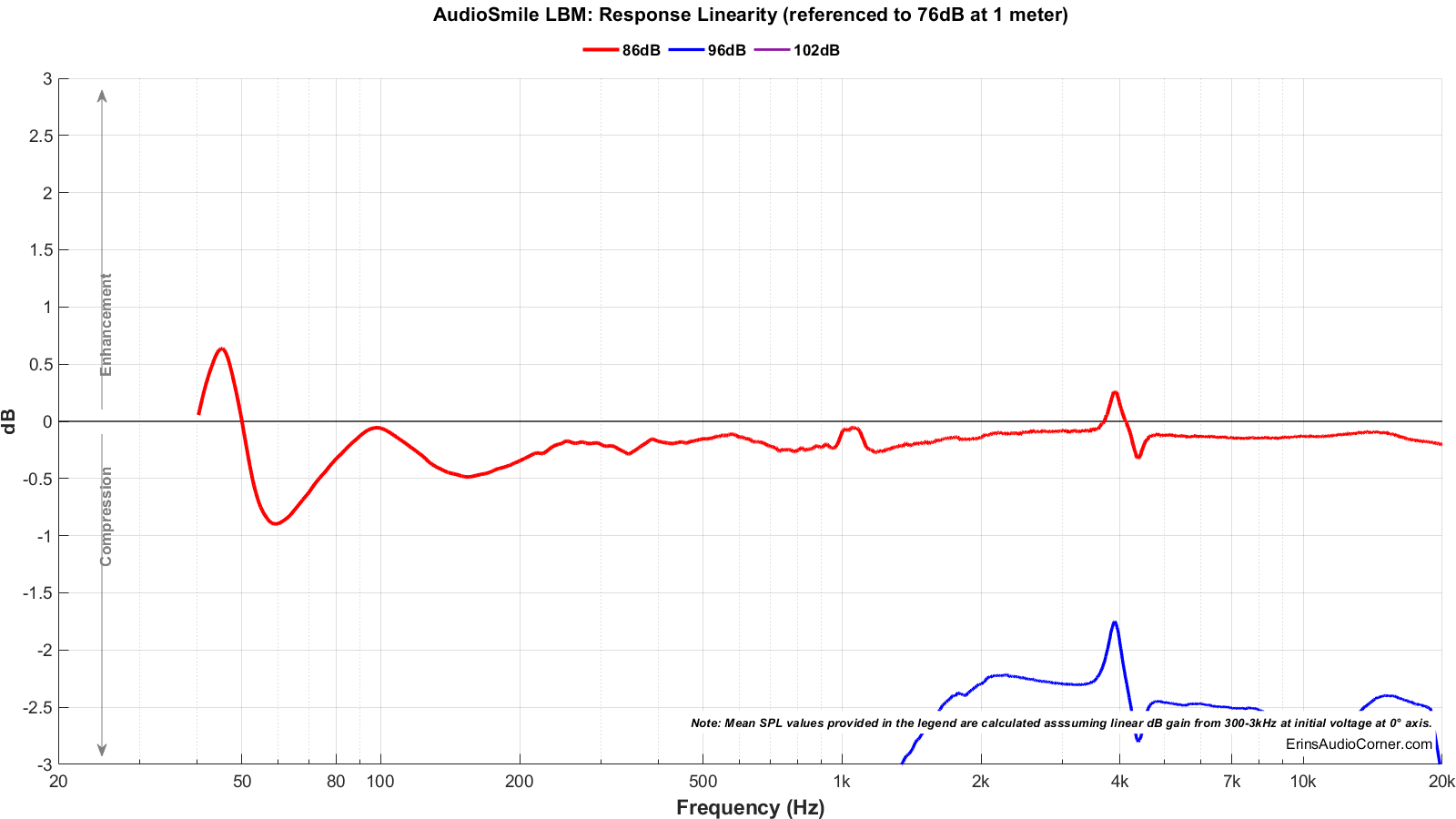
Dynamic Range (Instantaneous Compression Test)
The below graphic indicates just how much SPL is lost (compression) or gained (enhancement; usually due to distortion) when the speaker is played at higher output volumes instantly via a 2.7 second logarithmic sine sweep referenced to 76dB at 1 meter. The signals are played consecutively without any additional stimulus applied. Then normalized against the 76dB result.
The tests are conducted in this fashion:
- 76dB at 1 meter (baseline; black)
- 86dB at 1 meter (red)
- 96dB at 1 meter (blue)
- 102dB at 1 meter (purple)
The purpose of this test is to illustrate how much (if at all) the output changes as a speaker’s components temperature increases (i.e., voice coils, crossover components) instantaneously.
Multitone Distortion
The following tests are conducted at (4) approximate equivalent output volumes: 70/79/87/96dB @ 1 meter. The (4) voltages listed in the legend result in these SPL values. This test signal is dense, similar to pink noise and excites the entire spectrums listed below at the same time. The test signal lasts 30 seconds. This is different than the sine wave test signal used to measure frequency response. The purpose of this distortion and compression test is to illustrate how much (if at all) the output changes as a speaker’s components temperature increases (i.e., voice coils, crossover components) over time.
Given the test signal is similar to pink noise and exciting the entire spectrum at the same time I also include compression results, which is captured at the same time distortion is captured. Sometimes these results differ from the compression results you see above (namely with powered designs incorporating DSP-based limiting).
Note: The KLIPPEL software shows compression in the positive scale.
The test was conducted in (3) manners:
- Full bandwidth (20Hz to 20kHz)
- 80Hz to 20kHz
The reason for the two measurements is to simulate running the speaker full range vs using a high-pass filter at 80Hz. However, note: the 2nd test low frequency limit at 80Hz is a “brick wall” and doesn’t quite emulate a standard filter of 12 or 24dB/octave. But… it’s close enough to illustrate the point.
- Full bandwidth (20Hz to 20kHz)
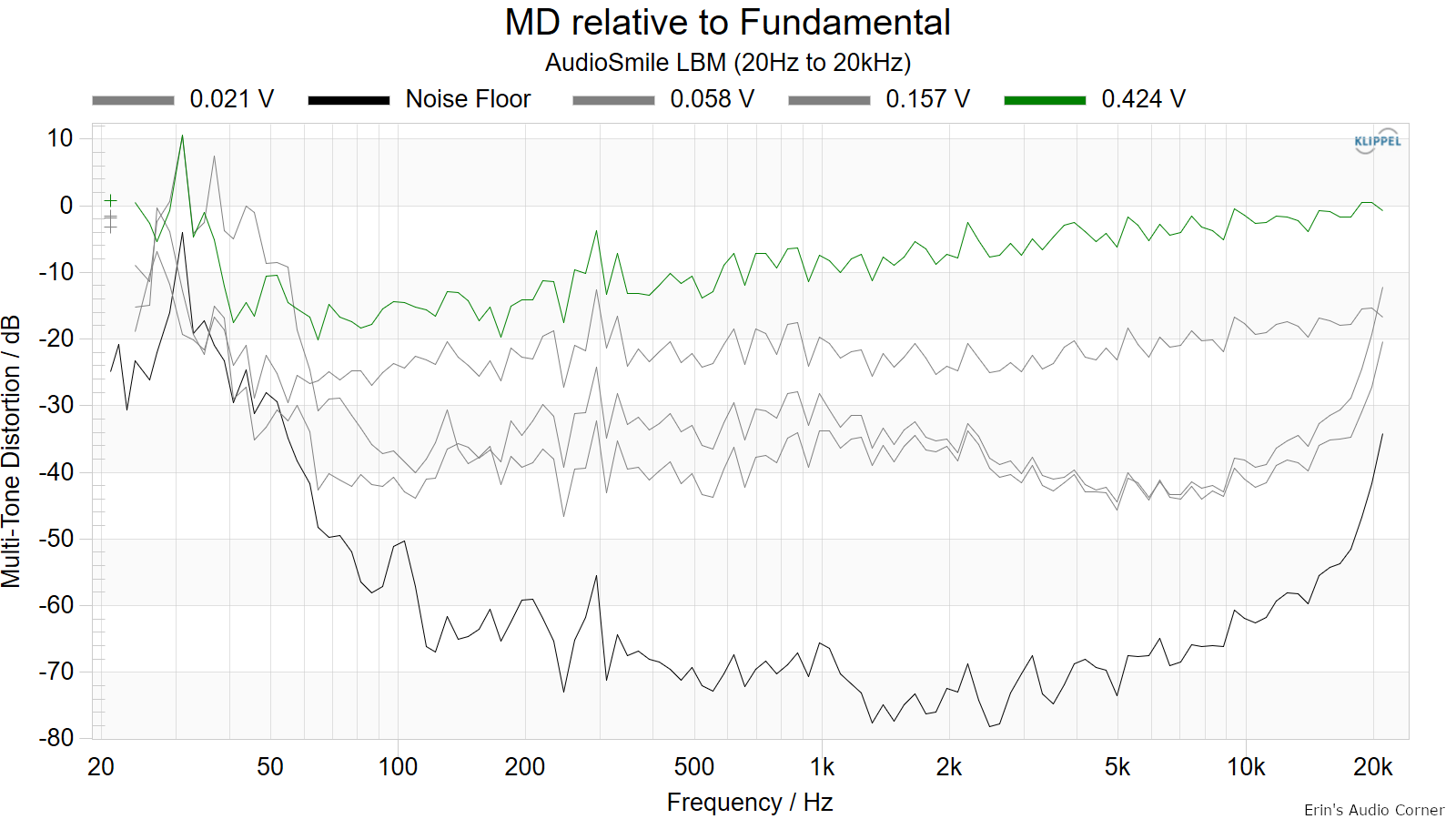
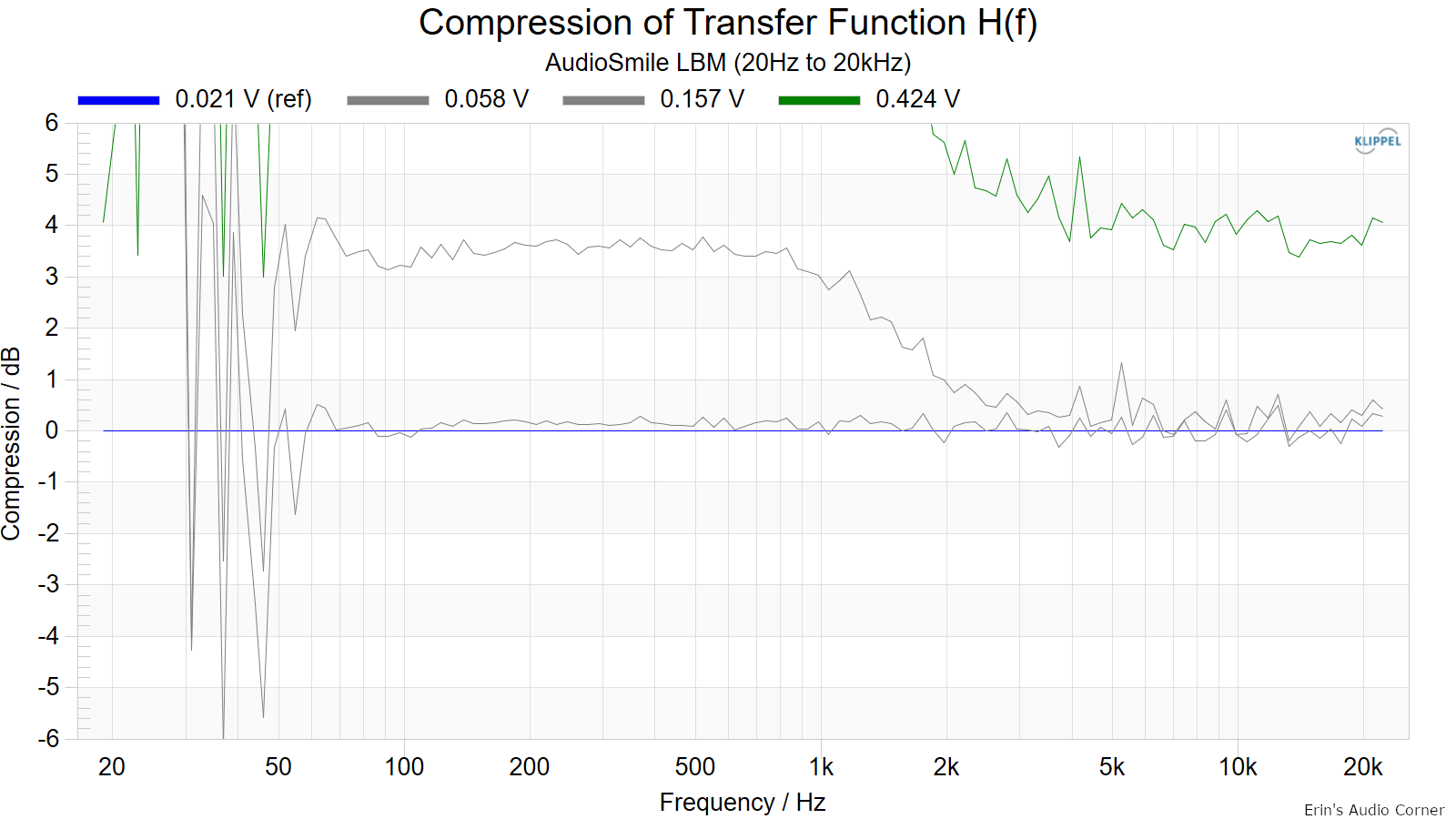
- 80Hz to 20kHz
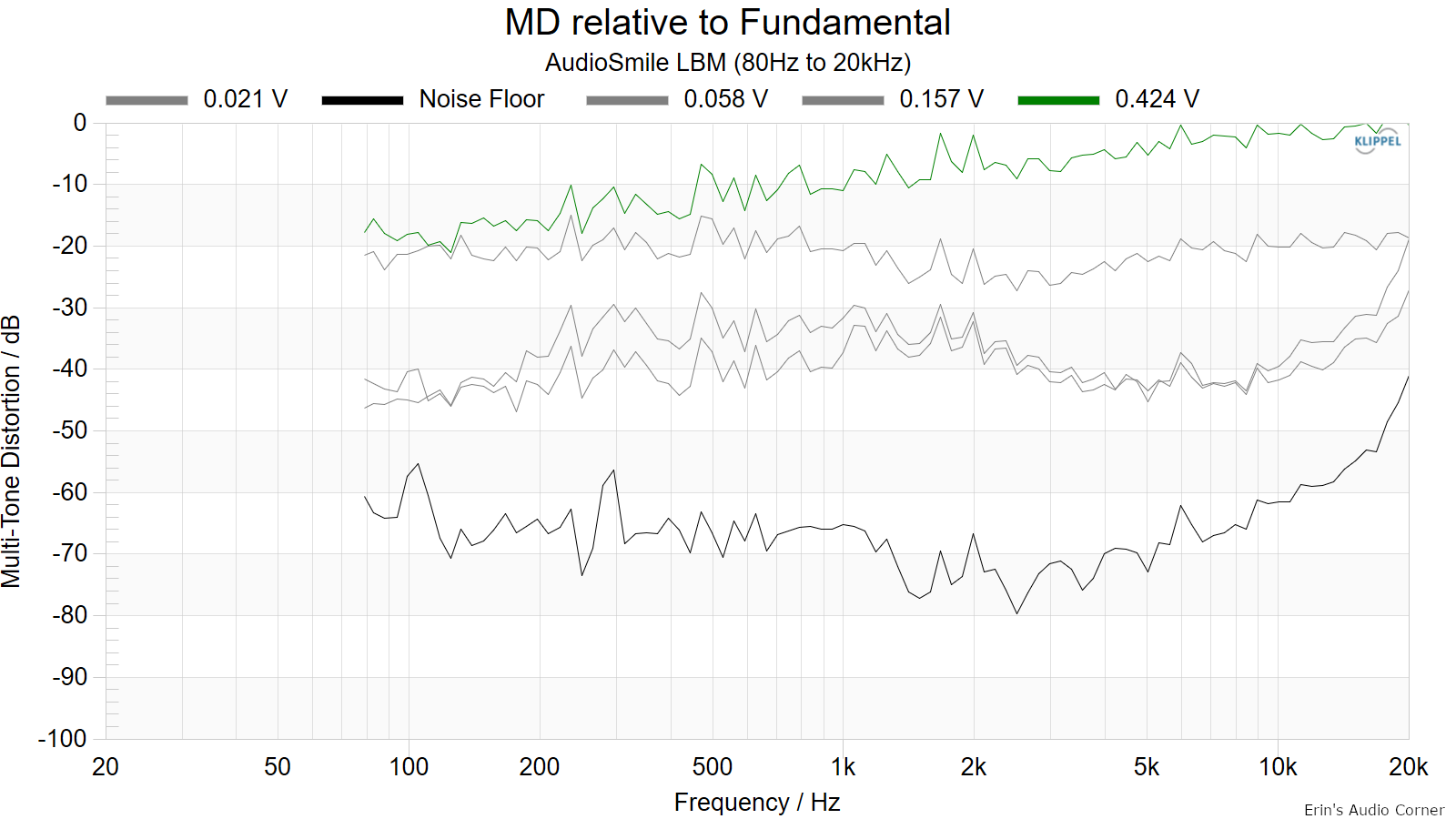
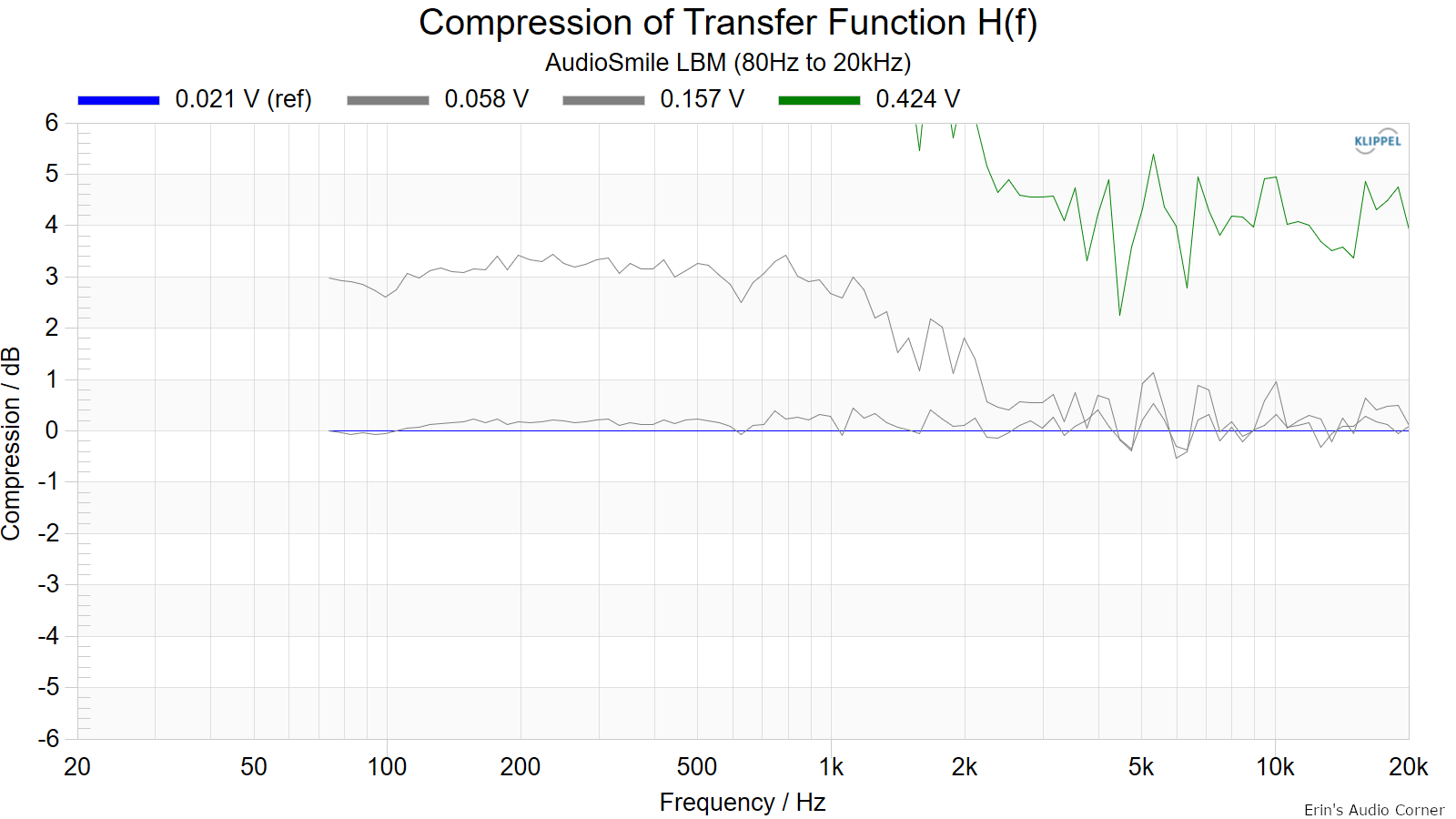
Parting / Random Thoughts
Re-iterating what I discussed in the setup section above: This speaker has various DSP options for boundary compensation. My testing was conducted with the boundary setting to “far” which results in an elevated bass profile. For a more nominally flat response the boundary setting should be positioned at the 12 o’clock position. These results are shown on Audio Science Review’s review (whew, redundancy!). Here is a link.
From the waveguide to the cabinet, this speaker is engineered to the hilt to provide accurate sound. While my sample was tested with the setting yielding bass boost, it’s obvious the various DSP options allow for a nominally-flat anechoic response as well. This results in subjectively pleasing sound with accuracy needed for production needs in a small footprint. Or just the casual enthusiast who may be on a more limited budget.
In the “sane SPL range” the f6 is measured at 63Hz and f10 at 51Hz. Like nearly every smaller desktop speaker this one uses a limiter to limit protect the drivers by limiting the output. Measured maximum SPL is approximately 86dB @ 1m for a single unit. If you’re looking for a speaker for farfield listening then I’d advise against this particular speaker due to the SPL limitation.
All said, this is a solid - pun intended - desktop speaker with great linearity that rivals and in some ways even bests some of the more well-known offerings from brands such as Genelec, Adam Audio and Kali Audio at a very competitive price.
Support / Contribute
I do not take adspace nor do manufacturers pay me for reviews. All revenue is through YouTube ad-revenue or directly from contributions from viewers such as yourself. While this is not my full-time job it’s cool when I’m able to make a few bucks for my efforts.
If you’d like to support the channel I have listed a few ways below. Thank you!
Patreon:
Want to be more involved? On Patreon you can vote in polls, see behind-the-scenes stuff, read about the occasional manufacturer drama (fun, right?), and help shape what I do next.
👉 https://www.patreon.com/erinsaudiocorner
Donate Via PayPal:
If you would like to contribute directly via PayPal that would be appreciated!
👉 https://www.paypal.com/donate?hosted_button_id=CLHSW4L9SBSLY
Generic Affiliate Links:
Anytime you’re buying something online — whether it’s speakers, TVs, or just everyday stuff — you can use the clickable links below. I get a small commission (at no extra cost to you), and it adds up more than you’d think.
Amazon
Crutchfield
Audio Advice
AsciLab Speakers
Arendal Sound
Best Buy
AliExpress
Wal-Mart
Parts-Express
Newegg
Samsung
Target
Thomann
Emotiva
Monoprice